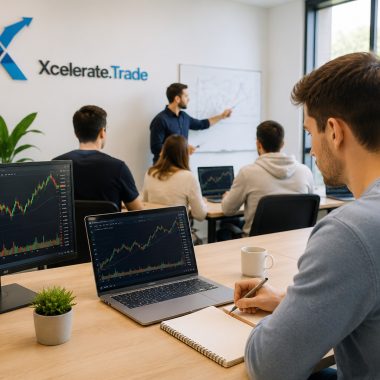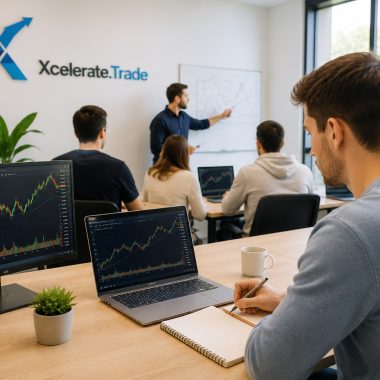

The first few minutes inside a trading education platform usually tell me more than the headline does. If I am immediately surrounded by unexplained jargon, dense charts, and assumptions about what I already know, I can usually tell that beginners were not the main audience.
Xcelerate Trade gives a different impression. Its learning path starts close to the beginning, with basic trading concepts and practical questions, then gradually moves into subjects such as risk management, technical analysis, trading psychology, execution, market structure, Smart Money Concepts, and more advanced trading tools.
That progression makes the answer fairly clear, although not completely black and white. I would describe Xcelerate.Trade as being built primarily for beginners and developing intermediate traders, with enough advanced material and additional tools to remain relevant to some experienced traders as well.
The important word there is developing. This does not feel like a platform built around the idea that someone should remain a beginner forever. The structure seems intended to move a trader from basic understanding toward a more organized and repeatable way of working.
Professionals can certainly find things worth examining, particularly among the more advanced tools and strategies. Still, I would not call Xcelerate Trade a professional-first platform in the same way I would describe specialized institutional trading software, execution infrastructure, or quantitative research systems.
For most people considering the platform, the real question is not whether they fit neatly into one label. It is whether Xcelerate Trade meets them at their current level and gives them enough room to progress without becoming irrelevant too quickly.
The Short Answer
Xcelerate Trade is most naturally suited to beginners and intermediate traders.
A complete beginner can start with foundational concepts without being expected to understand advanced chart terminology from the first lesson. Someone with some trading experience can move toward risk management, technical analysis, execution, psychology, Smart Money Concepts, backtesting, demo practice, prop trading concepts, and a more structured trading process.
Professional and highly experienced traders are a more mixed case. They are unlikely to need much of the introductory education, but they may still be interested in specific strategies, indicators, automation tools, replay features, market analysis frameworks, or other parts of the broader Xcelerate.Trade ecosystem.
So if I had to place the platform on a simple spectrum, I would put its center of gravity somewhere between beginner and intermediate. The advanced end is present, but it is not where the learning journey begins.
Why Xcelerate Trade Feels Accessible to Beginners
I remember what trading terminology looks like when somebody first encounters it. A chart that seems perfectly ordinary to an experienced trader can look like a wall of colored candles, lines, abbreviations, and numbers to someone who has never placed a trade.
Then the vocabulary starts arriving. Spread, margin, leverage, liquidity, position size, stop loss, risk-to-reward ratio, market structure, order types, volatility. A newcomer can easily spend an afternoon reading definitions and still feel less certain by dinner.
Xcelerate Trade appears to understand that problem. Its educational structure begins with introductory ideas rather than acting as though everybody already knows how markets work.
That matters more than it sounds. A beginner does not necessarily need more information than everyone else. Quite often, they need information in the right order.
Throwing a sophisticated strategy at somebody before they understand basic risk is a bit like teaching a person to drive quickly before showing them where the brake pedal is. They may remember the exciting part, but they are missing the part that keeps the whole exercise under control.
The learning path offered through Xcelerate Trade Academy follows a gradual progression from introductory material toward more advanced trading concepts. That structure is one of the clearest reasons I see the platform as beginner-friendly.
It does not mean every lesson will feel easy. Once market structure, liquidity, Smart Money Concepts, trade management, and execution start entering the picture, the amount of information increases quickly.
Still, a newcomer is not expected to begin there. That difference matters.
Beginner-Friendly Does Not Mean Beginner-Only
This is where I think the description of Xcelerate.Trade becomes more interesting.
Some trading courses are clearly entry-level products. They explain what a candlestick is, introduce a few indicators, discuss basic risk, and more or less end there.
Xcelerate Trade appears to be trying to build a longer road.
The curriculum moves beyond basic terminology into chart analysis, market behavior, risk control, psychology, execution, strategy development, and more specific ways of interpreting price action. There is also a wider set of tools and practice features surrounding the educational material.
That gives beginners somewhere to grow.
I see this as important because the first six months of learning trading are very different from the next eighteen. At the beginning, the trader is mostly trying to understand what everything means. Later, the challenge becomes deciding what actually matters.
Knowing twenty technical concepts does not automatically create a trading process. Sometimes it creates the opposite problem.
I have seen traders reach the point where every chart tells them five different stories. One indicator suggests buying, another suggests waiting, price is near a previous high, an online commentator is bearish, and somebody in a chat room has just announced that the market is about to explode higher.
That trader is no longer a complete beginner. But they are not yet working with a stable process either.
This is where intermediate-level education becomes more valuable.
Intermediate Traders May Be the Real Sweet Spot
If I had to choose the type of trader who could use the greatest portion of the Xcelerate Trade ecosystem, I would probably choose the developing intermediate trader.
This person already understands charts. They know what a stop loss does. They may have traded live, completed demo sessions, tested several strategies, or spent months studying technical analysis.
Their main problem is different now.
They know enough to trade, but they may not yet know how to trade consistently.
That distinction is easy to overlook. A person can understand market structure and still enter too early. They can know position sizing and still increase their risk after a losing trade.
They can talk confidently about discipline and then abandon their plan after two difficult mornings.
Intermediate traders often need fewer concepts and more organization.
That is one of the areas where Xcelerate.Trade seems reasonably well positioned. The education moves toward a more connected process involving technical analysis, risk, psychology, order execution, trade management, market structure, and repeated practice.
Those subjects begin to matter differently once somebody has real experience with mistakes.
A paragraph about emotional decision-making sounds abstract when someone has never traded. After a trader has watched themselves move a stop loss because they did not want to accept a small loss, the same paragraph suddenly becomes very concrete.
That is why I suspect intermediate traders may appreciate certain parts of the platform more than complete newcomers do.
The Difference Between Knowing Trading and Having a Process
One of the easiest mistakes in trading education is confusing knowledge with ability.
A trader may know the definition of a Break of Structure. They may understand liquidity. They may be able to identify support and resistance, calculate a risk-to-reward ratio, and explain several candlestick patterns without hesitation.
None of that guarantees they can sit in front of a moving chart and make a calm decision.
Live markets introduce time pressure. They also introduce uncertainty, money, regret, excitement, and the uncomfortable possibility that a perfectly reasonable decision may still lose.
This is the point where a trading process has to become more important than a prediction.
Xcelerate Trade places noticeable emphasis on structured decision-making, risk management, psychology, execution, and repeated practice. That moves the educational focus away from simply spotting patterns and closer to building routines around them.
I think that is a useful direction.
The trader who constantly asks what the market will do next usually ends up chasing certainty. The trader who asks what they will do if price reaches a certain level is asking a much more practical question.
The second trader is beginning to build a process.
Why Risk Management Matters So Much in Judging the Audience
I pay close attention to how trading platforms discuss risk because it reveals what kind of trader they expect to create.
If almost all the attention is on entries, profits, and impressive-looking setups, I become cautious. Entries are interesting, but they are only one part of trading.
A trader can have a decent strategy and still damage an account through poor position sizing.
They can also take perfectly acceptable losses and turn them into serious problems by increasing risk emotionally. This usually does not happen because the person forgot the definition of a stop loss.
It happens because behavior changes when money is involved.
Xcelerate Trade includes risk and money management as part of the educational process rather than treating them as an appendix. The material deals with ideas such as defining risk before entering a trade, adjusting position size according to the stop distance, controlling exposure, and placing limits around a trading session.
Those are not purely beginner concepts.
A beginner should certainly learn them early, but an intermediate trader often has enough market experience to understand why they matter. The lesson becomes personal after someone has already felt the urge to recover a loss immediately.
That is another reason I see the platform as extending beyond the beginner stage.
Trading Psychology Is Not Just an Advanced Buzzword
Trading psychology is one of those subjects that sounds vague until it becomes painfully specific.
It can mean pressing the buy button because you are afraid the move will leave without you. It can mean closing a good trade early because a tiny pullback makes you nervous.
It can also mean taking another trade twenty seconds after a loss, even though the second setup is worse than the first.
People sometimes treat these behaviors as personality problems. I think that oversimplifies things.
Markets create conditions that naturally provoke emotional responses. Price moves quickly, outcomes are uncertain, and every decision produces immediate feedback in the form of profit or loss.
A decent trading process therefore needs rules for behavior, not only rules for charts.
Xcelerate.Trade includes psychology alongside its more technical material. That makes sense for a platform trying to take traders beyond the introductory stage.
A complete beginner may initially think psychology means staying calm. An intermediate trader begins to understand that psychology is often built into the structure of the process itself.
Smaller risk can reduce emotional pressure. A predefined stop can remove an argument you would otherwise have with yourself.
A limit on the number of trades can prevent frustration from turning into overtrading. Good psychology is often less dramatic than people expect.
Sometimes it is simply the result of having fewer decisions to improvise.
Smart Money Concepts Raise the Level of the Curriculum
The platform’s use of Smart Money Concepts is another reason I would not classify it as purely beginner-focused.
Smart Money Concepts generally involve reading price through ideas such as market structure, liquidity, structural shifts, institutional behavior, and specific areas where price may react. The terminology can become fairly dense for somebody meeting it for the first time.
A newcomer can learn it, of course.
The question is whether they should attempt to absorb everything at once. I would not.
I would first want a beginner to understand basic chart behavior, risk, position sizing, and execution. Once that foundation feels familiar, concepts involving structural changes and liquidity become easier to place in context.
Intermediate traders are usually in a better position to evaluate this material critically.
They already have enough chart experience to compare a new framework with what they have seen before. Instead of simply memorizing labels, they can ask whether those labels help them make better decisions.
That is the more useful question.
Any methodology can look convincing on a clean historical chart. Real usefulness appears when rules can be stated clearly, tested repeatedly, and followed without the benefit of knowing what happens next.
Historical Replay Changes the Quality of Practice
This is one of the areas I find particularly relevant for developing traders.
Looking at old charts is easy. Practicing honestly on old charts is harder.
When the entire historical chart is visible, your brain already knows more than it should. You can see that price eventually rallied, so the earlier pullback suddenly looks obvious.
You can see that a support level held, so the entry appears cleaner in hindsight.
Historical replay helps remove some of that hindsight.
By revealing price gradually, replay practice forces the trader to make decisions with incomplete information. That is much closer to the psychological experience of a live market.
Xcelerate Trade incorporates replay and demo-style practice into the broader development environment. For an intermediate trader, I think this can be more useful than reading another hundred pages of theory.
The value comes from repetition.
A trader can test whether the same setup can be recognized across different market conditions. They can also record where the rules become unclear.
That second part is important.
A strategy that looks beautifully precise in a written document may turn out to contain several vague decisions once somebody actually tries to execute it twenty or thirty times.
Replay exposes those weak spots.
Demo Trading Makes the Most Sense When It Has a Purpose
Demo trading has a strange reputation.
Some people dismiss it because no real money is involved. Others stay on demo for so long that they never confront the emotional side of live execution.
I think both views miss the point.
Demo trading is useful when the trader knows what they are practicing.
If the goal is to learn how an order works, test a process, become comfortable with a platform, or gather a sample of trades without risking capital, demo trading is perfectly sensible.
If the goal is to prove how someone will behave emotionally with meaningful money at risk, it obviously has limits.
Xcelerate.Trade presents demo practice as part of the learning progression. That makes the most sense to me when beginners use it to convert theory into routine before they start thinking about live capital or funded trading.
For intermediate traders, demo sessions can serve another purpose.
They can provide a controlled place to test changes.
Instead of altering a live strategy because of three bad trades, the trader can take the revised idea back into a practice environment and see whether it actually improves anything.
That is a more patient way to learn.
Trading could use more patience.
Prop Trading Content Signals a More Developed User
The platform also discusses proprietary trading firms and funded trading evaluations.
That subject sits naturally later in a trader’s development.
A completely new trader does not need to worry about passing a funded-account challenge. They need to understand whether they can follow a basic trading plan without changing it every few days.
Once a trader has a tested method, prop-style rules become more relevant.
Those evaluations often introduce limits on losses, drawdown conditions, profit targets, position restrictions, or other requirements. A strategy that looks reasonable in a personal account may behave differently under those constraints.
This is another area where Xcelerate Trade begins to look more intermediate than beginner.
The educational path encourages practice and consistency before treating funded trading as the next obvious step. I think that order matters.
Large account figures can be psychologically seductive.
They can make somebody feel as though they have progressed simply because a larger number is being displayed on a screen. The actual question remains whether the person can manage risk and execute a process consistently.
Without that, the account size is mostly decoration.
Is Xcelerate.Trade Suitable for Complete Beginners?
Yes, with one important qualification.
The education appears accessible enough for somebody starting from scratch, but day trading itself should never be confused with a low-risk beginner activity.
Financial regulators such as FINRA have repeatedly warned that day trading can involve substantial risk and may be inappropriate for people with limited trading experience, limited financial resources, or low tolerance for losses. Leverage can make that risk even more severe.
That context matters.
A beginner-friendly course can make complicated ideas easier to understand. It cannot make the market safe.
I would therefore see Xcelerate Trade as most suitable for beginners when education and simulated practice come first.
Someone who feels pressure to recover the cost of a course by trading aggressively has already created the wrong problem.
Learning should reduce the urgency to trade.
It should not increase it.
What Beginners Are Likely to Get From Xcelerate Trade
The strongest benefit for a beginner is probably structure.
There is an enormous amount of free trading information online. The difficulty is no longer finding information.
The difficulty is deciding what to learn first and what to ignore.
A structured path can save a newcomer from jumping randomly between concepts.
One day they watch a video about RSI. The next day they discover order blocks.
By Friday they are studying options, macroeconomics, scalping, Elliott Wave Theory, and somebody’s five-minute breakout strategy.
That kind of learning feels productive because the person is constantly busy.
Usually it produces fragments.
Xcelerate.Trade gives the learner a sequence. The beginner can work through foundations before moving toward technical structure, risk, psychology, execution, and more specialized methodology.
That does not guarantee mastery.
It simply creates a better environment for it.
What Intermediate Traders Are Likely to Get From Xcelerate Trade
Intermediate traders have a different opportunity.
They can use the platform to compare their existing habits with a more formal process.
Perhaps their entries are already good but risk varies from trade to trade. Maybe they understand risk but never keep proper records.
They may journal consistently but lack a clear definition of what actually makes a setup valid.
A structured framework can make those gaps visible.
This is why the intermediate stage is so interesting to me. The trader knows enough to notice where their process is weak.
They also know enough to challenge what they are being taught.
That second ability matters.
A trader should not accept a methodology merely because it is presented confidently. They should test it.
They should ask whether the rules are clear, whether the setup appears often enough, whether transaction costs matter, whether it behaves differently across market conditions, and whether the risk profile fits their own tolerance.
Xcelerate Trade provides material that can support that kind of development.
The trader still has to do the testing.
Where Professionals Fit Into Xcelerate Trade
Professional traders are harder to place because the word professional covers several very different kinds of people.
An independent trader who has spent years developing a personal intraday method has one set of needs.
A trader working at a financial institution may have another.
A quantitative researcher, portfolio manager, proprietary trader, or execution specialist may barely recognize one another’s daily work, even though all of them could reasonably be called professionals.
That makes it difficult for any broad retail-focused ecosystem to be built equally for all professionals.
Xcelerate.Trade does offer advanced features that experienced traders may find useful. These include strategy-related tools, indicators, automation concepts, replay functionality, performance tracking, and a broader ecosystem that reaches beyond introductory education.
The difference is that an experienced trader probably will not consume the platform in the same way a beginner does.
They are more likely to evaluate individual pieces.
A professional may skip foundational chapters almost entirely and look at whether a particular tool improves research, execution, testing, or workflow.
That is a sensible way to approach it.
Experience changes what a person needs from education.
Why I Would Not Call Xcelerate Trade a Professional-First Platform
The simplest reason is that the platform spends too much effort making the early stages accessible.
A product designed exclusively for professionals would normally assume much more knowledge at the entrance.
It would not need to spend much time explaining basic trading concepts or helping someone understand what kind of setup they need to begin studying markets.
Xcelerate Trade does.
That tells me the beginner is not an afterthought.
The platform seems to want beginners inside the ecosystem, then gradually introduces them to more complex material as they progress.
That is fundamentally different from a professional tool that assumes the user already has years of experience.
It does not make the platform less serious.
It simply tells us who the full journey is built around.
Professional Traders May Still Find Specific Tools Relevant
I would not dismiss the professional use case, though.
Experienced traders are often selective consumers of information.
They may ignore ninety percent of an educational platform and still find one indicator, one automation idea, one execution framework, or one analytical concept worth testing.
That can be enough.
A professional usually does not need another complete identity as a trader. They already have one.
What they may need is a tool that saves time, exposes a weakness, improves record keeping, speeds up testing, or introduces a useful way of looking at familiar information.
Xcelerate Trade’s broader ecosystem potentially serves that kind of user better than the introductory education alone.
The key word is potentially.
Experienced traders should evaluate every advanced tool against their existing process rather than assuming that more complexity means better trading.
Often it does not.
The Platform Has a Point of View, and That Matters
No trading education is truly neutral.
The moment a course decides what to teach first, which markets to focus on, which chart concepts matter, and how a setup should be interpreted, it has chosen a point of view.
Xcelerate.Trade leans toward intraday trading and Smart Money Concepts.
That gives the curriculum coherence.
Instead of presenting fifty unrelated strategies and leaving the learner to assemble them, it develops a more specific interpretation of market behavior.
For the right trader, that can be helpful.
For somebody interested mainly in long-term investing, fundamental stock selection, options volatility strategies, quantitative portfolio management, or high-frequency execution, it may be much less relevant.
That is not really a criticism.
A useful course does not have to cover the entire financial universe.
It needs to be clear about the part of the universe it is trying to teach.
What Kind of Beginner Is the Best Fit?
I think Xcelerate Trade fits a particular kind of beginner better than others.
The ideal beginner is probably someone who wants structure, is willing to study before risking meaningful capital, and does not expect a trading strategy to behave like a guaranteed formula.
They should also be comfortable with gradual learning.
Someone looking only for instant signals may find a structured curriculum unnecessarily slow.
I would argue that the slowness is useful.
There is already enough speed in trading.
Charts move quickly. Decisions can happen quickly.
Losses certainly happen quickly.
Learning does not have to.
What Kind of Intermediate Trader Is the Best Fit?
The strongest intermediate fit is probably the trader who has accumulated knowledge but still lacks consistency.
They understand the language of trading and have spent enough time on charts to recognize recurring patterns.
What they may lack is a firm routine for preparation, execution, risk, and review.
This trader often feels strangely stuck.
They are clearly no longer a beginner, yet results still depend too heavily on mood, market conditions, or whatever idea looked convincing that morning.
A structured framework can help turn that vague experience into something measurable.
Perhaps the setup is fine but the entry is inconsistent.
Perhaps the entry is consistent but the stop placement changes.
Perhaps both are reasonable, but the trader takes three unnecessary trades after the first loss.
These are intermediate problems.
They are also the kinds of problems that rarely disappear after watching another strategy video.
What Kind of Professional Is the Best Fit?
The professional most likely to find value in Xcelerate.Trade is probably an experienced independent trader who is open to testing new tools without feeling compelled to rebuild an already functional process.
That person can move through the platform selectively.
They may examine a strategy, compare an indicator with their current analysis, test an automation feature, review replay functionality, or study a different interpretation of market structure.
Institutional professionals may find the fit narrower.
Their requirements can involve execution infrastructure, deep data access, research systems, compliance, portfolio-level risk, APIs, or other specialized functions that sit outside the core purpose of a retail trading education ecosystem.
This distinction is worth making because professional does not simply mean advanced beginner.
It can describe an entirely different working environment.
A Note About the Wider Xcelerate.Trade Ecosystem
Xcelerate.Trade is not presented only as a collection of lessons.
The broader ecosystem includes education, trading-related tools, strategies, indicators, practice environments, premium features, community elements, and token-linked components.
That creates more possible uses, but it also gives potential users another decision to make.
A person may like the educational material without necessarily wanting every surrounding feature.
Another trader may care less about the introductory content and more about specific advanced tools.
I think it is healthier to separate those judgments.
The quality of an educational framework should be evaluated on whether it helps a trader understand and practice a repeatable process.
The value of an indicator should be evaluated on whether it adds useful information.
The value of an automation system should be evaluated on testing, reliability, risk controls, and how it behaves outside ideal historical examples.
Different products deserve different tests.
Putting them under one brand does not make them the same decision.
Is Xcelerate Trade Better for Beginners Than Intermediate Traders?
I would say it is easier for beginners to enter, but potentially more useful in full for intermediate traders.
That sounds contradictory until you think about how much of the platform each group is likely to use.
A beginner benefits immediately from the foundation.
They may spend weeks or months simply learning terminology, charts, risk, and basic market behavior.
An intermediate trader can move through that material faster and engage more deeply with the later sections.
They can use replay, technical structure, risk management, psychology, strategy concepts, and execution practice with more context.
That is why I would call the platform beginner-accessible but intermediate-rich.
The entrance belongs to beginners.
Much of the middle belongs to developing traders.
The advanced end becomes more selective.
Is Xcelerate.Trade Advanced Enough for Experienced Traders?
For some experienced traders, yes.
For all experienced traders, probably not.
That is the most reasonable answer.
An experienced retail trader may find useful material in the advanced concepts, analytical tools, indicators, replay features, strategy framework, or automation-related parts of the ecosystem.
A highly specialized professional may find that the educational material covers ground they mastered years ago.
Neither reaction would be surprising.
The mistake would be assuming that experience automatically makes every feature irrelevant.
Professionals still learn.
They simply become more selective about what deserves their time.
The Biggest Strength Is Probably the Progression
When I look at Xcelerate Trade as a whole, the strongest idea is not any single trading concept.
It is the progression.
The platform gives someone a place to begin, then gradually introduces the harder parts of trading.
That sounds ordinary until you compare it with the way many people actually learn markets.
Most begin in the middle.
They discover a strategy first, then learn risk later.
They learn an indicator before understanding market structure.
They open a live account before learning how position size is calculated.
Sometimes they learn what overtrading means only after spending a painful afternoon doing exactly that.
A structured sequence cannot prevent every mistake.
It can at least put the lessons in a more sensible order.
The Biggest Limitation Is That Structure Cannot Replace Experience
This is the other side of the argument.
A well-organized education platform can shorten the path to understanding.
It cannot remove uncertainty from trading.
A person can complete every chapter and still struggle the first time a live market moves sharply against them.
They can understand risk mathematically and still feel tempted to ignore it emotionally.
They can identify a textbook setup and still take the wrong one ten minutes later.
Experience matters because markets do not present themselves like course examples.
Charts become messy.
Context changes.
Some days the best decision is to do nothing, which is a surprisingly difficult skill to practice because nothing produces no immediate reward.
That is why I would judge Xcelerate Trade as a framework for development rather than a shortcut to professional status.
The distinction is important.
My Verdict for Beginners
For complete beginners, Xcelerate Trade appears to offer a sensible starting structure.
The introductory progression, attention to fundamental concepts, risk education, psychology, technical analysis, and practice-oriented approach make it possible to enter without already speaking the language of an experienced trader.
I would still encourage a beginner to move slowly.
Understanding the material should come before trying to prove anything with money.
The strongest use of the platform at this stage is education, chart familiarity, demo practice, and gradual development of a repeatable routine.
The goal should not be to become aggressive more quickly.
It should be to become less confused.
That is a much better milestone.
My Verdict for Intermediate Traders
Intermediate traders may be the group with the strongest overall fit.
They are experienced enough to understand why risk management, psychology, backtesting, replay, technical structure, and execution matter.
At the same time, they may still have enough weaknesses in their process to benefit from a structured framework.
This group can also evaluate the material more critically.
They can compare it with strategies they have already tried and with mistakes they have already made.
They can ask whether a concept improves decision-making rather than simply whether it sounds sophisticated.
That is usually where trading education becomes more productive.
My Verdict for Professional Traders
Professional traders are not the primary audience of the complete learning journey.
The early educational material will be too basic for many of them.
The more advanced parts of Xcelerate.Trade may still deserve attention, especially for experienced independent traders interested in specific tools, analytical concepts, strategies, indicators, replay functionality, or automation.
I would approach those parts individually.
A professional does not need to adopt an entire ecosystem to find one useful component.
They also should not assume a tool is useful simply because it is described as advanced.
Testing still matters.
It always does.
Who Is Xcelerate Trade Really Built For?
My final view is that Xcelerate Trade is built most naturally for beginners who want room to grow and intermediate traders who want more structure.
It is accessible at the beginning without staying basic all the way through.
The platform gradually introduces technical analysis, risk management, psychology, Smart Money Concepts, execution, replay, strategy development, and other topics that become more relevant as a trader gains experience.
Professional traders sit on the edge of that audience rather than at its center.
They may find useful advanced components, but they are unlikely to need the entire educational path.
If I were new to trading, I would value the fact that Xcelerate.Trade gives me somewhere clear to start.
If I were already trading but struggling with consistency, I would probably pay closer attention to the middle of the journey, where risk, psychology, structure, review, and execution begin to connect.
If I were already a professional, I would be selective.
I would test individual tools against the process I already trust.
That is probably the fairest answer to the original question. Xcelerate Trade is beginner-friendly, strongly relevant to intermediate traders, and selectively useful for professionals.
The platform can provide the map.
The trader still has to walk the ground.
Frequently Asked Questions About Xcelerate Trade
Is Xcelerate Trade suitable for complete beginners?
Yes. Xcelerate Trade is structured so that someone with little or no trading experience can begin with foundational concepts before moving into more technical subjects.
A beginner should still treat the early stage primarily as education and practice. Trading, particularly short-term trading with leverage, can involve substantial financial risk, so understanding risk management should come before committing meaningful capital.
Is Xcelerate.Trade mainly a beginner trading course?
No. Although beginners have a clear entry point, the curriculum develops into more advanced areas such as technical analysis, market structure, Smart Money Concepts, risk management, trading psychology, execution, replay practice, and strategy development.
That makes the platform broader than a simple introductory course. Intermediate traders are likely to find a significant portion of the later material relevant to their development.
Is Xcelerate Trade good for intermediate traders?
Intermediate traders may be the strongest overall fit for Xcelerate Trade. They already understand the basics and can therefore focus more heavily on developing consistency, refining risk rules, practicing execution, reviewing mistakes, and creating a repeatable trading process.
The platform is especially relevant to traders who have learned several concepts but still feel that their trading lacks structure. At that stage, organization and disciplined execution can matter more than collecting additional strategies.
Can professional traders use Xcelerate.Trade?
Yes, although professional traders are unlikely to need the entire educational path. Experienced users may be more interested in selected advanced features, strategies, indicators, replay tools, analytical frameworks, or automation-related components.
The value will depend heavily on the trader’s existing process. A professional should evaluate individual tools through testing rather than assuming that the entire ecosystem is necessary.
Does Xcelerate Trade teach Smart Money Concepts?
Yes. Smart Money Concepts form an important part of the more advanced educational material.
The approach includes concepts related to market structure, liquidity, structural changes, and price behavior. Beginners can learn these ideas, but they are generally easier to understand once basic chart reading, risk management, and execution are already familiar.
Does Xcelerate.Trade include risk management education?
Yes. Risk management is part of the broader educational framework rather than being treated as a secondary subject.
The material addresses areas such as predefined trade risk, position sizing, stop placement, exposure, and behavioral controls around trading sessions. These concepts are important for beginners and remain relevant even for experienced traders.
Is Xcelerate Trade suitable for day traders?
Xcelerate Trade has a strong intraday and short-term trading orientation, so it is likely to be most relevant to people interested in active trading rather than purely long-term investing.
That does not mean day trading is appropriate for everyone. Short-term trading can carry substantial risk, especially when leverage is involved, and traders should consider their financial circumstances, experience, and tolerance for loss before risking capital.
Can I use Xcelerate.Trade if I already know technical analysis?
Yes. A trader who already understands technical analysis can still use the platform selectively and focus on areas such as market structure, risk management, psychology, Smart Money Concepts, execution practice, replay, or more advanced strategy material.
Experienced users may move through introductory sections more quickly. The more important question is whether the later framework adds something useful to their existing process.
Is Xcelerate Trade more suitable for beginners or intermediate traders?
Xcelerate Trade is easier for beginners to enter, but intermediate traders may get more value from the platform as a whole.
Beginners benefit from the structured foundation, while intermediate traders can make greater use of the later material involving risk, psychology, execution, advanced chart concepts, replay, and strategy development. For that reason, the fairest description is beginner-friendly with a strong intermediate focus.
Will Xcelerate.Trade make someone a professional trader?
No trading education platform can guarantee that outcome.
Xcelerate.Trade can provide education, frameworks, practice tools, and a more structured development path, but becoming a consistently competent trader depends on practice, risk control, testing, experience, capital management, and the ability to follow a process under uncertainty.