
I have seen a familiar scene more times than I can count. Someone buys a trading course late at night, watches a few polished videos, opens a chart the next morning, and realizes almost nothing on the screen feels connected to what they just learned. The lesson sounded clean, but the market looks messy, loud, and a little rude.
That gap is where most traditional trading education platforms quietly fail people. They often teach information in neat compartments, then leave the learner alone when it is time to make an actual decision under pressure. Knowledge sits in one box, execution in another, risk in a third, and confidence never quite arrives.
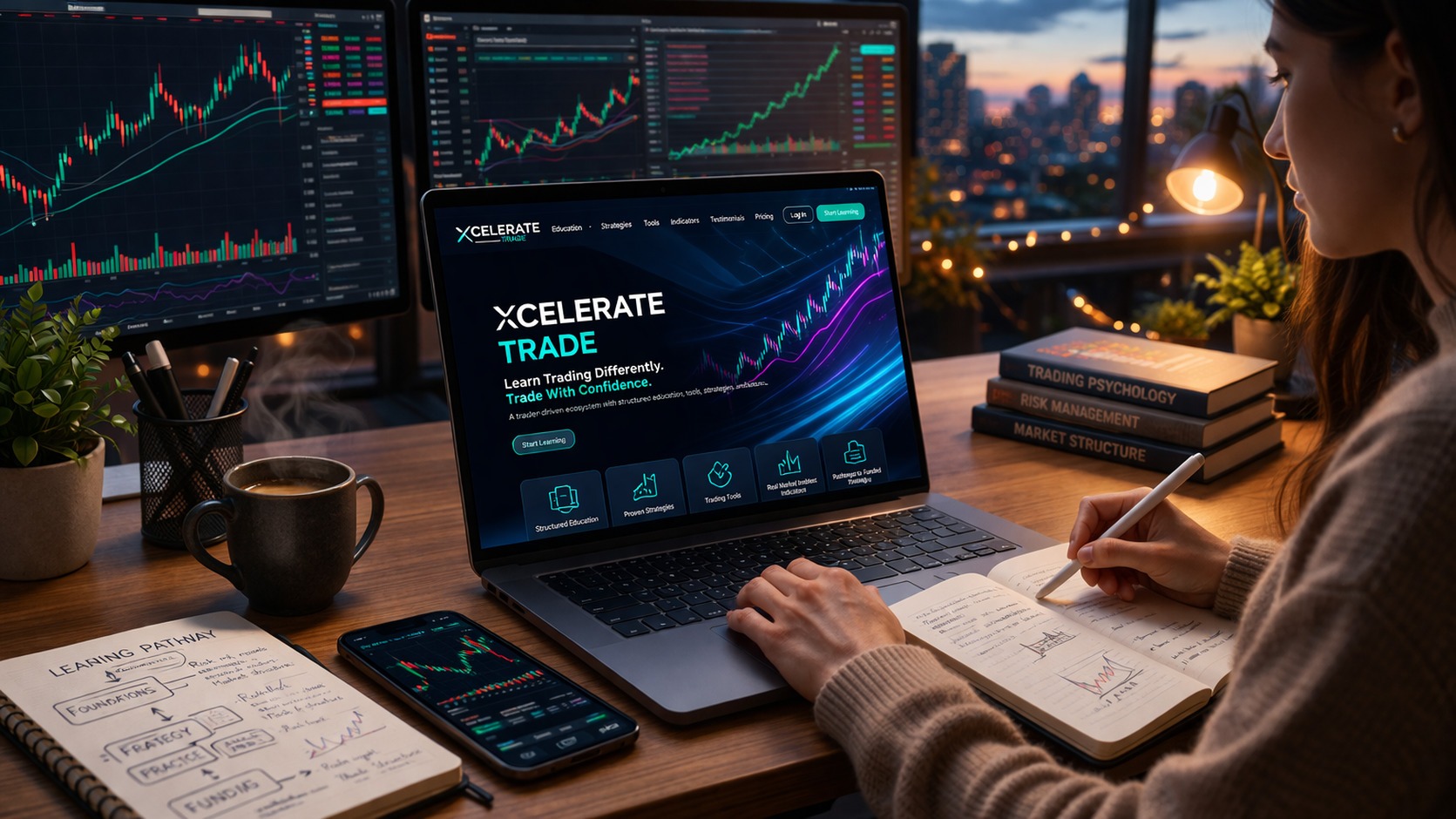
Xcelerate Trade appears to be built around a different assumption. On its official site, it presents itself as a trader driven ecosystem built around structured education, tools, strategies, indicators, and utility rather than a simple course shelf. That framing already separates it from the older education model, because it suggests an environment people use, not just a folder of lessons they consume.
That difference matters more than it sounds. A lot of people do not fail in trading because they are lazy or incapable. They fail because they are taught in fragments, and then expected to behave like professionals in an environment that exposes confusion almost immediately.
The old model usually sells knowledge, not transformation
Traditional trading education platforms tend to follow a pattern that feels efficient on paper. There is a beginner course, a technical analysis course, maybe a candlestick course, maybe a psychology module, then a private group where alerts appear like weather warnings. It looks complete from the outside.
In practice, though, these pieces often live beside each other rather than inside each other. The student learns support and resistance on Tuesday, risk management on Thursday, and maybe options basics the week after that, but nobody truly shows how those pieces should meet inside one calm, disciplined decision. That is a bigger problem than most course sellers admit.
It reminds me a little of being handed recipe cards without ever standing in a kitchen. You can memorize temperatures, ingredients, timing, and theory, but once the pan is hot and something starts sticking, the room changes. Trading has that same uncomfortable honesty.
Many traditional platforms also depend heavily on content volume as a sign of value. They advertise fifty modules, hundreds of videos, lifetime access, downloadable PDFs, and weekly webinars. The learner feels rich in material and poor in clarity.
That distinction is not just semantic. Information abundance can actually make beginners worse, because they start confusing exposure with competence. Watching a lot of trading content is not the same thing as building decision quality.
Xcelerate Trade seems to organize learning as a pathway, not a pile
One of the clearer ways Xcelerate Trade separates itself is by framing learning as a structured route instead of a content dump. That sounds simple, maybe even obvious, but it changes the student experience in a deep way. A route tells you what comes first, what comes later, and why the order matters.
Traditional education platforms often behave like giant digital bookstores. They let you wander. Wandering can feel empowering at first, but in trading it often becomes expensive.
Xcelerate Trade has been described as building Learning Pathways, and that phrase matters because it suggests progression with direction. Rather than telling everyone to consume everything, the platform appears to guide learners through stages that connect market understanding, execution mechanics, and broader development as traders. That is much closer to how real skill is built in any high pressure field.
A serious learner does not only need answers. They also need sequencing. They need to know what to ignore for now, what to master before moving on, and what kind of mistakes belong to their stage rather than to some imagined personal failure.
That is one of the quiet benefits of a structured system. It reduces random wandering, and random wandering is one of the hidden costs of retail trading education. People lose months, sometimes years, not because they never study, but because they study sideways.
The platform seems to connect education with execution
Here is where the difference becomes more practical. A lot of traditional trading platforms stop at explanation. They teach chart patterns, market sessions, indicators, and maybe a few rules, then they hand the student a login and wish them luck. It is education as a broadcast.
Xcelerate Trade looks closer to education as an operating environment. The learning is tied to tools, strategies, indicators, and execution features rather than being sealed off from them. That matters because trading is not just an intellectual skill. It is a procedural one.
You can explain risk management beautifully in a lesson, but until a student sees how position sizing, drawdown tolerance, entry quality, and trade duration interact in a live environment, the lesson remains a little abstract. People do not usually break rules because they never heard the rules. They break them because they never internalized them.
When a platform tries to bridge that gap, something shifts. The learner stops being a viewer and starts becoming an operator. That is a very different identity.
At a human level, this matters because many newer traders are not really looking for content. They are looking for traction. They want a system that helps them move from I kind of understand this to I can repeat this under stress.
Cross market education changes the learner’s mental map
Another weakness of many traditional trading education businesses is that they teach one market as if it were the whole world. Someone becomes the crypto person, or the forex person, or the options person, and all their reasoning starts living inside that single lane. The market, of course, does not respect those boundaries.
Capital moves. Liquidity rotates. Risk appetite rises in one pocket and disappears in another. A trader who only learns one corner of the map may still make money for a while, but their understanding stays narrow.
Xcelerate Trade appears to push beyond that narrow framing by connecting crypto with more traditional markets such as equities, indices, forex, futures, and options. That is not just a feature expansion for marketing purposes. Done properly, it changes how a trader interprets the world.
A person who studies only isolated setups may become reactive. A person who studies how different markets relate to each other begins to notice structure. They start asking better questions. Why is the dollar moving this way? What does bond pressure mean for equities? Why does crypto suddenly feel heavy when liquidity tightens elsewhere?
That is where trading education starts to mature. It stops being about memorizing setups and starts becoming a way of reading behavior across systems.
Traditional platforms often teach indicators first and judgment later
This is one of my bigger frustrations with old style trading education. Many platforms rush students into indicator based decision making because indicators are easy to package, easy to screenshot, and easy to sell. They create the feeling of precision.
The trouble is that beginners often start hunting for confirmation instead of learning context. They pile tools on a chart and assume more signals must mean more safety. Usually it means more hesitation, more narrative, and more excuses after the fact.
Xcelerate Trade seems to present tools and in house indicators inside a broader framework of structure, risk parameters, and changing market conditions. That is a healthier way to introduce tools. A good indicator should support judgment, not replace it.
There is a world of difference between a platform saying here are ten indicators and another saying here is the logic behind when a tool helps, when it misleads, and how it fits inside an actual plan. One sells a shortcut. The other tries to build a process.
In trading, process is what keeps people alive long enough to improve. That sounds dramatic, maybe a bit stern, but the charts do not care how inspired someone feels.
It appears to take prop firm standards seriously
A lot of trading education platforms still act as if profitability is a vague personal journey. They talk about mindset, patience, and discipline, which are all real things, sure, but they do not place the learner inside meaningful external constraints. Without constraints, discipline stays theoretical.
Xcelerate Trade seems to move learners toward prop firm style evaluation standards, including exposure to drawdown limits, risk controls, and scaling logic. That is useful because prop environments force clarity. You cannot hide inside motivational language when a hard rule ends the attempt.
This is where traditional education often feels oddly soft. It tells students to trade like professionals while shielding them from the systems professionals actually have to respect. Then the learner meets those rules later and feels blindsided.
By contrast, a platform that introduces institutional style boundaries earlier gives the student a more honest education. It says, in effect, your strategy is not enough on its own. Your execution must survive rules, pressure, and consistency requirements.
That is a much tougher lesson, but it is also more respectful. It treats the learner like someone who might eventually be accountable for real performance rather than like a permanent consumer of inspiration.
The community layer seems designed for participation, not just spectatorship
Anyone who has spent time around trading communities knows the difference between a live community and a noisy audience. One helps you think. The other just keeps you stimulated.
Traditional platforms often bolt on a Discord or Telegram room as a bonus. The room fills with charts, hot takes, win screenshots, panic during red candles, and the occasional thoughtful person who tries to help. It can be energizing, but it can also become a carnival of secondhand emotion.
Xcelerate Trade positions itself more like a trader driven ecosystem, which suggests the community is part of the platform logic rather than just an afterthought. That wording matters. An ecosystem implies interaction between learning, execution, market commentary, tools, and participation.
That can create a very different atmosphere for learners. Instead of consuming occasional lessons and then drifting into random online chatter, they remain inside one environment where the educational framework and the day to day market conversation are meant to reinforce each other.
There is something grounding about that. Trading is lonely in a way people outside it often underestimate. A good ecosystem does not remove responsibility, but it can reduce the sense that you are solving every problem in the dark.
Copy trading and automation are treated as analytical tools, not fantasy buttons
This may be one of the more underrated differences. Plenty of traditional trading education platforms either avoid automation entirely or treat it like a flashy add on for advanced users. Others go in the opposite direction and sell bots as if code could rescue weak judgment. Both extremes miss the point.
What stands out in the way Xcelerate Trade is described is that copy trading and bot trading are framed as structured systems to be evaluated, not magical shortcuts. That is a healthier premise. It encourages learners to study performance behavior, parameter logic, and risk calibration instead of becoming passive believers.
That distinction matters because automation often attracts exactly the people most vulnerable to false certainty. They are tired, they want relief, and a machine feels cleaner than their own emotional decision making. I understand the appeal, honestly.
But real progress comes when automation becomes another lens for understanding structure. A trader starts asking different questions. What assumptions does this bot make about volatility? What kind of market regime hurts it? How long can the strategy stay underwater before the numbers become unacceptable?
That is education with teeth. It does not say, sit back and let technology save you. It says, learn to interrogate systems the same way you would interrogate your own trade idea.
Proprietary strategies change the value proposition when they are tied to clear logic
A lot of legacy platforms sell generic education that could have been recorded by almost anyone with a ring light and decent editing. The explanations are polished, the vocabulary is familiar, and the examples feel oddly recycled. You finish a lesson with the strange sense that you learned something and nothing at all.
Xcelerate Trade emphasizes proprietary strategies and internally developed indicators. On its own, that does not automatically make a platform better. Plenty of people call something proprietary when they just want it to sound exclusive.
The real difference comes down to whether those strategies are presented as repeatable frameworks with entry logic, risk conditions, and adaptive rules. If they are, then learners are not simply buying access to information. They are entering a working methodology.
That changes the relationship between teacher and student. Instead of here is what markets are, it becomes here is how we think, how we filter, how we enter, how we protect capital, and how we respond when conditions change.
That kind of specificity is rare, and it is one reason some newer ecosystems feel more relevant than older course libraries. Relevance in trading usually comes from application, not polish.
Traditional education often isolates psychology from mechanics
This is a subtle but important point. Most classic trading courses include a psychology section, usually somewhere in the middle or near the end. It talks about fear, greed, discipline, revenge trading, patience, confidence. All true. All useful. Often too detached from the actual mechanics that trigger those emotions.
The problem is that bad psychology is frequently a symptom of weak structure. A trader feels fear because they oversized. They revenge trade because the original plan was vague. They hesitate because their criteria were never clear enough to begin with. The emotion is real, but it is not floating in space.
A platform like Xcelerate Trade looks different because the surrounding system appears built to connect judgment, risk, tools, and execution. When those elements are integrated, psychology becomes less mystical. It is still hard, sure, but it becomes more manageable because the trader has a framework to lean on.
This is one of those things people only appreciate after a few rough months in the market. Confidence does not usually come from hype. It comes from seeing your process hold together repeatedly, including when a trade loses.
It seems closer to an ecosystem business than a course business
The older model of trading education is mostly transactional. You buy access, consume material, maybe join a chat room, maybe upgrade later, maybe disappear quietly if things do not click. The business succeeds if enrollment continues.
Xcelerate Trade appears to be pursuing a broader ecosystem model where education sits alongside tools, gated features, strategies, insights, and token based access mechanics. Whether someone loves tokenization or not, the structural point is interesting. The platform is not presenting itself as a one off course purchase.
It is presenting itself as an environment with multiple layers of participation.
That changes incentives. Course businesses sometimes benefit when students stay dependent. Ecosystem businesses, at least in theory, benefit when users remain active, engaged, and growing inside the system because the value is spread across usage, access, and ongoing participation.
I would be careful not to romanticize that automatically. Any ecosystem can become bloated or overly complicated if it forgets the learner. Still, the move away from static education into living infrastructure is one of the more meaningful differences here.
Why this distinction matters for beginners
Beginners usually think they need more information than they actually do. What they often need is a better container for the information they already have. They need fewer disconnected lessons, fewer dramatic promises, fewer screenshots of overnight gains, and more practical architecture.
Traditional platforms can leave beginners with a strange kind of educational jet lag. They have heard the language of trading but cannot yet speak it under pressure. They know what a stop loss is, but not how to place one in a way that respects structure. They know risk matters, but still do not feel it in their hands.
A structured ecosystem helps because it reduces the number of gaps between learning and use. The student is not constantly jumping from course to chart to social media guru to random tool to community rumor. Everything, ideally, begins to point in the same direction.
That coherence is underrated. It saves mental energy, and mental energy is precious when you are trying to build skill in a field that can humble you before breakfast.
Why it also matters for intermediate traders
Intermediate traders are in a different kind of danger. They know enough to feel capable, but not always enough to see where their reasoning is still fragile. This is the stage where people often hop between strategies, adjust variables endlessly, or convince themselves that one missing tool is the final answer.
For them, the value of a platform like Xcelerate Trade may not be basic instruction. It may be integration. They already know some concepts, maybe many. What they lack is a tighter operating system.
That is where cross market exposure, structured execution features, and a more professional framework can become useful. Instead of learning more fragments, they start refining alignment. Their entries, sizing, market context, review process, and expectations begin to belong to the same language.
That sounds less exciting than finding the perfect setup, I know. But in real trading, boring alignment tends to age better than exciting confusion.
The biggest difference may be philosophical
Underneath all the features, the real divide may be philosophical. Traditional trading education often assumes that if people are given enough knowledge, they will eventually turn themselves into traders. It is a very consumer era assumption.
The Xcelerate Trade approach, at least from the way it is publicly framed, suggests something more grounded. It seems to assume that traders are developed through systems, structured progression, tools, constraints, and repeated interaction with real market behavior. That is a more demanding philosophy.
It is also, frankly, a more believable one.
Nobody becomes a competent surgeon by owning a medical library. Nobody becomes a good pilot by watching endless cockpit videos. Trading should probably stop pretending it is the one serious discipline where content alone can carry the whole burden.
That is why this comparison matters. We are not really talking about prettier dashboards or newer branding. We are talking about two different ideas of how human skill is built.
Why Xcelerate Trade feels more current in 2026
The timing matters too. Trading education no longer lives in the same internet culture it did a few years ago. Learners are more skeptical, platforms are more crowded, and people have grown tired of buying static courses that leave them alone right where things become difficult.
A platform that combines structured learning, platform tools, strategy logic, execution context, and community participation simply feels more aligned with how digital users expect to learn now. They do not want ten isolated logins and a folder full of theory. They want one place that reduces friction between learning, testing, and refining.
That does not mean every modern ecosystem automatically deserves trust. Some are all packaging and no spine. Still, when a platform is built around real use rather than passive consumption, it starts with an advantage that many older education businesses never really solved.
A more honest way to think about the choice
Not every trader needs the same environment. Some people are highly self directed, deeply disciplined, and able to build their own process from books, charts, and careful review. They exist. They are just rarer than the internet likes to imply.
Most people need more scaffolding than that, especially early on. They need an environment that narrows chaos, organizes progression, and makes application part of the learning process rather than a lonely afterthought.
That is where Xcelerate Trade seems to differ most clearly from traditional trading education platforms. It is not simply offering lessons about trading. It is trying to create a framework in which trading skill can be developed, tested, and extended into more real forms of participation.
And maybe that is the point that stays with me. In a field crowded with courses that promise insight, a platform that tries to build structure may not feel louder, but it does feel closer to how people actually learn when money, uncertainty, and pressure are all sitting at the same table.